Awhile back I had a trader email requesting I code this indicator for Thinkorswim. At the time I wasn’t able to get to it, and I’ve subsequently lost the email, so I thought I would put this out there in the universe in case he happens to run across it here, and in case anyone else can use it.
“The output of the indicator is the amount of momentum a security has, that is in excess of its average volatility, expressed as a percentage. We are measuring directional strength, “purified” from volatility fluctuations”
Alex Spiroglou
Traditional MACD vs. Volatility Normalized MACD-V for Thinkorswim
TSLA Tesla TMO Relative Strength True Momentum Oscillator Strategy for Thinkorswim
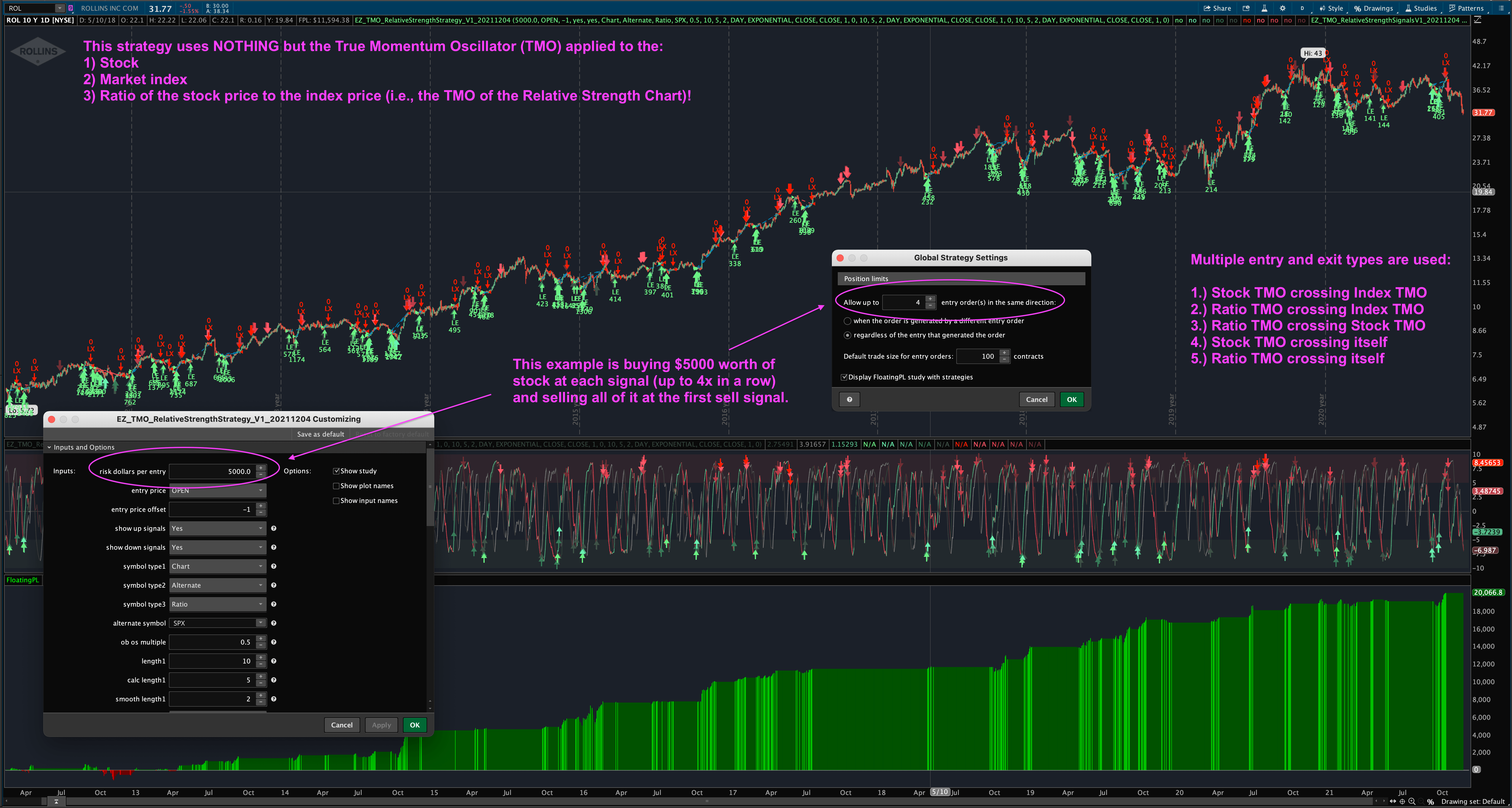
The idea behind this new script is to calculate the TMO for 3 different sources:
The stock itself
A market index symbol such as SPX or /NQ
The relative strength ratio of the stock divided by the index symbol
Then, by comparing the TMO output of each of these sources, we can identify points in time where the stock’s momentum first begins to outperform the overall market early on, while it’s still trading inside a base or pullback pattern.
The remarkable thing to me is that this strategy can be broadly profitable on most stocks just using the built-in divergence signals between the 3 TMOs, and no additional filters like MAs or other trend filters.
The other remarkable feature is that this seems to be a timeless source of edge: if many people start using these signals, it will likely create new divergences to take advantage of.
The set comes with a scan, column, 2 indicators, and a strategy for backtesting, and by default it compares the currently-charted stock to the SPX through the lens of the TMO.
This suite of tools is available for free to anyone who has previously purchased the Relative Strength indicator set, and from now on it will also be included for new customers as well.
I had a request to do this indicator from a customer and I thought it would be a useful tool, so I got to work on it. I’ve added this as a free bonus to the existing Anchored VWAP and VWAP multiple timeframe set here.
The basic idea is you can define your Zig Zags as usual with the built in Zig Zag indicator. But instead of just plotting zig zags, the indicator will plot volume profiles for each wave/swing, and additionally anchor VWAPs to the most recent 5 swing high/low pivot points and plot them forward in time to present.
Here’s a quick walk through:
Thinkorswim automatic Zig Zag Anchored aVWAP and Volume Profile
Get the indicator here (or if you’re an existing owner download it in the My Account > Orders > View Order Details page):
Josiah is a stock & futures trader, ThinkScript programmer, Bitcoin maximalist, gold bug, real estate investor, and budding mountaineer. He's also rumored to be an in-shower opera singer. Josiah started Easycators in 2014 and lives with his family near Nashville, TN. xTwitter | YouTube