Posted on

VIX Stretches Trading Strategy for SPY

VIX Stretches by Connors and Alvarez

The VIX Stretches Trading Strategy for ThinkOrSwim

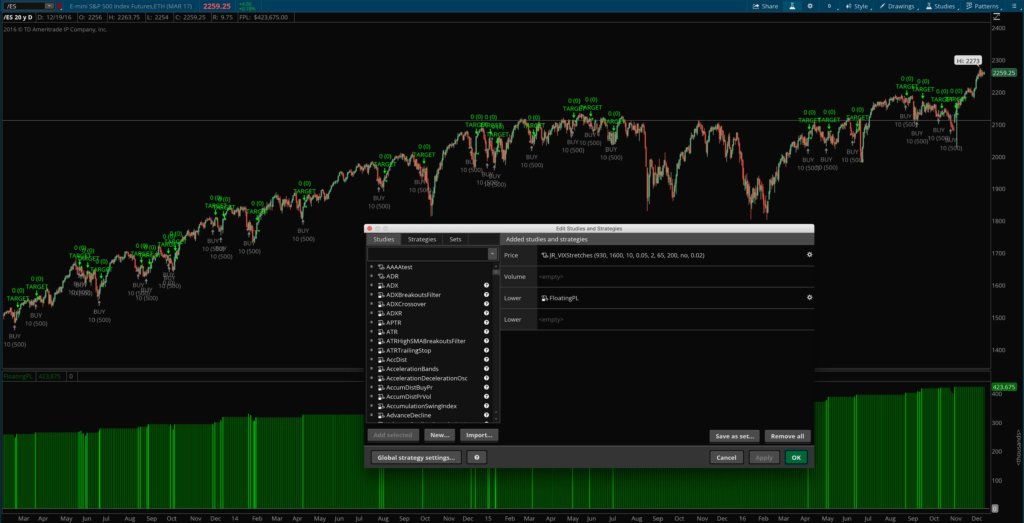
The VIX Stretches Trading Strategy is discussed by Larry Connors and Cesar Alvarez in their excellent book, “Short Term Trading Strategies that Work“. The strategy is based on the idea that when the VIX gets stretched above its simple moving average by a certain amount, and it stays stretched for a certain number of days, the statistical likelihood of a market advance increases, giving edge to people buying the market.

The Authors’ Stats:

  • Instrument: SPY
  • Win Rate: 84.85%
  • # Trades: 33
  • SPX points gained: 363.9
  • Avg. Holding Time: under 5 days

What You Get

  • The VIX Stretches strategy file for thinkorswim
  • All parameters are customizable in the properties menu, including SPY sma length, VIX sma length, VIX stretch percent, RSI parameters, etc.
  • Customizable market hours
  • Option to use a percentage-based stop or not to use a stop
  • Specify the size of stop to use, if any
  • Customizable colors

Why You Want It

  • The extremely high win/loss ratio on the SPY and SPX, as demonstrated by the authors, makes it an easy strategy to trade from a psychological standpoint
  • Option to add a stop makes the strategy even more easy to trade
  • Long-only strategy further makes it suitable for almost anyone, regardless of the type of account they trade out of
  • Ability to quantitatively backtest the strategy on multiple instruments, timeframes, and conditions affords more peace of mind and encourages traders to fully trust in their system

How it Works

The VIX stretch strategy is fairly simple to understand: the idea is we want to buy the SPY when the VIX gets stretched — and stays stretched — above its 10-period SMA for several days. Under the default settings, when the VIX is stretched more than 5% above its 10-period SMA for 3 days, and the market itself is currently trading above its 200 SMA (indicating a primary uptrend), then a buy signal is issued. A sell signal is issued when the RSI(2) of the SPY closes above an overbought reading of 65.


Original price was: $69.99.Current price is: $49.99.Add to cart


VIX Stretches Trading Strategy


Original price was: $69.99.Current price is: $49.99.Add to cart


Posted on

Double 7s Trading Strategy for ThinkOrSwim

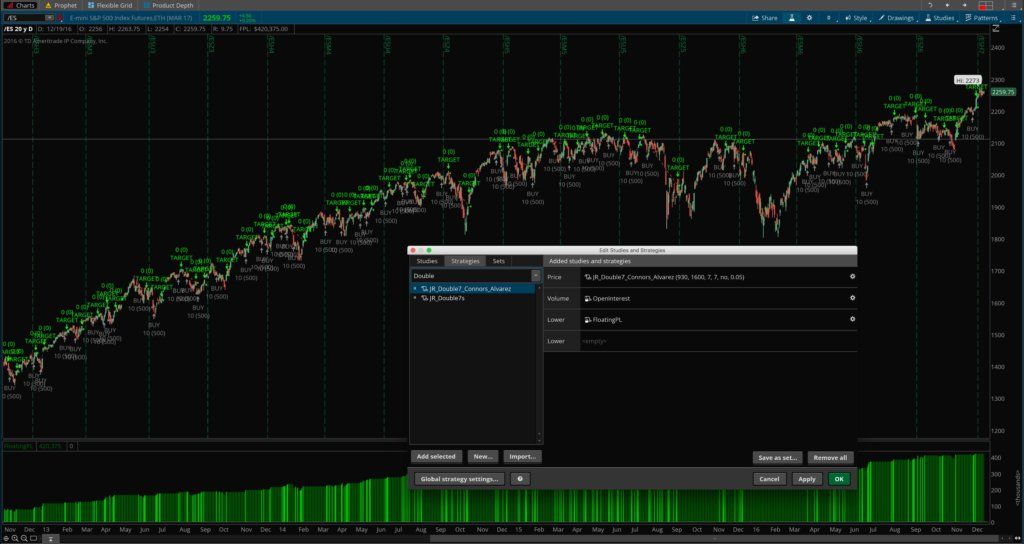
Connors & Alvarez Double 7s from Short Term Trading Strategies That Work

Double 7s Trading Strategy for ThinkOrSwim

Larry Connors and Cesar Alvarez promote the Double 7s trading strategy in their excellent book, “Short Term Trading Strategies that Work“. The basic idea is that, statistically, you only want to be buying the market on dips — you really don’t want to be buying breakouts. Breakouts work, but only in limited circumstances, so they take extra care, practice, and analysis. Trend pullbacks are much lower risk and much easier to succeed at, having an obvious statistical edge, so all of Connors’ and Alvarez’s strategies revolve around those types of setups. And toward that end, the Double 7s strategy offers an elegantly simple and sweet implementation of the pullback concept.

This strategy can be tested and optimized on any timeframe and any instrument. The authors focused on the SPY, QQQ, China’s FXI, and Brazil’s EWZ in the book, all of which showed stellar win/loss ratios.

The Authors’ Stats:

  • Instrument: SPY
  • Test dates: 1/29/93 – publication date
  • Win Rate: 80.4%
  • # Trades: 153
  • Avg. P&L: .85%
  • Net points: 122.36
  • Strategy locked in more than all of the gains the SPY made during the test period, while only being exposed to the market less than 25% of the time.

The QQQs, FXI, and EWZ each boasted 79.4%, 76.9%, and 81% win rates, respectively, and the book further details their results.

What You Get

  • The Double 7s strategy file for thinkorswim
  • All parameters are customizable in the properties menu, including pullback and follow-through lengths
  • Customizable market hours
  • Option to use a percentage-based stop or not to use a stop
  • Specify the size of stop to use, if any
  • Customizable colors

Why You Want It

  • The extremely high win/loss ratio on the SPY and other instruments, as demonstrated by the authors, makes it an easy strategy to trade from a psychological standpoint
  • Option to add a stop makes the strategy even more easy to trade
  • Long-only strategy further makes it suitable for almost anyone, regardless of the type of account they trade out of
  • Ability to quantitatively backtest the strategy on multiple instruments, timeframes, and conditions affords more peace of mind and encourages traders to fully trust in their system

How it Works

The Double 7s strategy is simple and sweet, and that’s what makes it so good. You look to buy when the market closes at a new x-number-of-days low, and look to sell when the market closes at a new x-number-of-days high. The default settings are those specified, tested and verified by the authors in the book.


Original price was: $69.99.Current price is: $49.99.Add to cart


Double 7s trading strategy from Short Term Trading Strategies That Work


Original price was: $69.99.Current price is: $49.99.Add to cart


Posted on

Cumulative RSI Trading Strategy for ThinkOrSwim (2 period)

Larry Connors and Cesar Alvarez Cumulative RSI Strategy

Cumulative RSI trading strategy for ThinkOrSwim

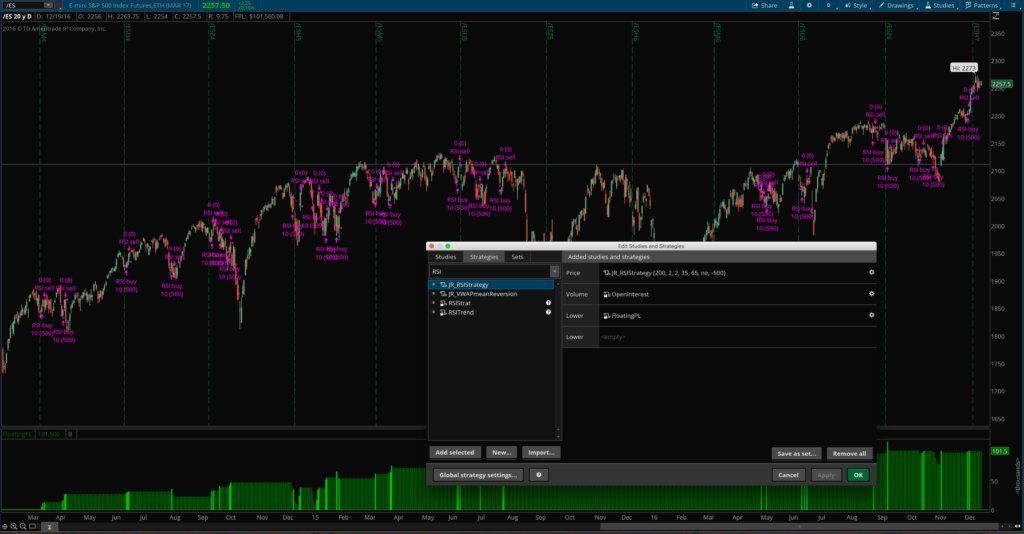
The cumulative RSI trading strategy (2 period) comes straight out of Larry Connors’ & Cesar Alvarez’s book called “Short Term Trading Strategies that Work“. I’ve really been enjoying programming and testing some of the ideas presented in their book — a lot of which seem to have some merit — so I wanted to go ahead and share some of the work I’ve been doing with my readers. On page 67 of their book, Connors and Alvarez state that this strategy was 88% accurate on the SPY when tested from 1993 through the date of publication, earning 65.53 SPY points with an average gain of 1.26% and and average holding period of 3.7 trading days.

The default settings (200, 2, 2, 35, 65, no) that the trading strategy comes with are straight out of the book on page 67, and seem to perform very well in my own tests, but they can be easily customized and tested with different values using the strategy properties menu. This is useful for quickly backtesting the strategy with different instruments, time frames, and market conditions.

Alternate Settings

The alternate settings the authors suggest on page 68, for reference, are as follows: (200, 2, 2, 50, 65, no). These settings resulted in more trades and larger gains during the same time period, and only slightly decreased the accuracy, so it was a beneficial trade off. The results of those settings according to the authors were 85.46% winners, 105.95 total SPY points made, with an average gain of 1.05% and and average holding period of 3.57 trading days. The authors noted that this strategy picked up about the same number of points the SPY had done in the prior 15 years while only being in the market 20% of the time, greatly reducing risk exposure.

The original cumulative RSI trading strategy in the book calls for no stop to be used, but I went ahead and added the option for a percentage based stop to make the strategy more applicable to different trading styles and time frames.

Results from thinkorswim strategy backtests can easily be exported and analyzed further in Excel or other spreadsheet programs simply by right-clicking on a strategy signal on the chart and clicking “Export” in the popup menu.

The Authors’ Stats:

  • Instrument: SPY
  • Test period: Almost 15 years
  • Win Rate: 88%
  • # Trades: 50
  • Avg. P&L: 1.26%
  • Net points: 65.53
  • Avg. Holding Time: 3.7 trading days

What You Get

  • Cumulative RSIs strategy file for thinkorswim
  • All parameters are customizable in the properties menu
  • Option to use a stop or not to use a stop, and to set the size in %
  • Customizable colors

Why You Want It

  • The extremely high win/loss ratio on the SPY and other instruments makes it an easy strategy to trade from a psychological standpoint
  • Option to add a stop makes the strategy even more easy to trade
  • Long-only strategy further makes it even easier to trade for almost anyone, regardless of what type of account they trade out of
  • Ability to quantitatively backtest the strategy on multiple instruments, timeframes, and conditions affords more peace of mind and encourages traders to fully trust in their system.

How it Works

The cumulative RSIs strategy first makes sure the instrument is in a long term uptrend (with customizable parameters), and then takes the sum of the past x-number of RSI(y) values and if the number is sufficiently oversold, the strategy issues a buy signal, and if it then becomes sufficiently overbought, it issues a sell to close signal. The overbought and oversold levels can be customized as needed. Traders can optionally add a money stop to the strategy (simple option in the properties menu) and customize how big the money stop should be.


Original price was: $69.99.Current price is: $49.99.Add to cart


cumulative RSI trading strategy


Original price was: $69.99.Current price is: $49.99.Add to cart