Posted on

Cumulative TICK Indicator for ThinkOrSwim – New and Improved!

New & Improved Cumulative Tick Indicator

Awhile back I posted the Cumulative TICK indicator on the downloads page, but after experimenting around with it for the past several days I wanted to do some updates and improvements. So I’ve just posted the new code on the site and anyone who has downloaded it before will have immediate access to the new code and the new features. I always want to make sure I offer a good product and good value, so your feedback is important to me. Please let me know in the comments if there are any additional features you are looking for and I’ll see if I can incorporate them in the next version. I’m always programming something, so usually it doesn’t take too long for me to improve things.

What’s New

So first of all, I realized that the old indicator didn’t seem to work properly on certain instruments and timeframes due to data peculiarities in TOS. So I fleshed out the code to account for those situations, and now the indicator works on futures like the E-mini S&P 500 as well as stocks and ETFs. And it also works on any timeframe … monthly, daily, hourly, etc. Originally it had only worked in the way Dr. Brett Steenbarger originally used it and talked about it on his blog. But I realized a lot of traders would probably adjust it to their own trading styles, so I wanted it to work for every situation possible. And now it does that.

Second, to make it useful on long-term historical charts, I wanted to add some features. Normally, since the market rises generally over time, the cumulative TICK just keeps growing and growing. The adjusted cumulative TICK fixes part of that by subtracting a moving average to turn the output into more of an oscillator. But on long-term charts that still didn’t fully solve the ever-growing graph problem. What I needed was a “reset” function for long-term charts the same way intraday charts reset at the beginning of each day. So what I did was add the option to have it reset each year, month, or week. Each of these can be independently set.

Third, I’ve added the ability to choose your own average type and length for the Adjusted Cumulative TICK.

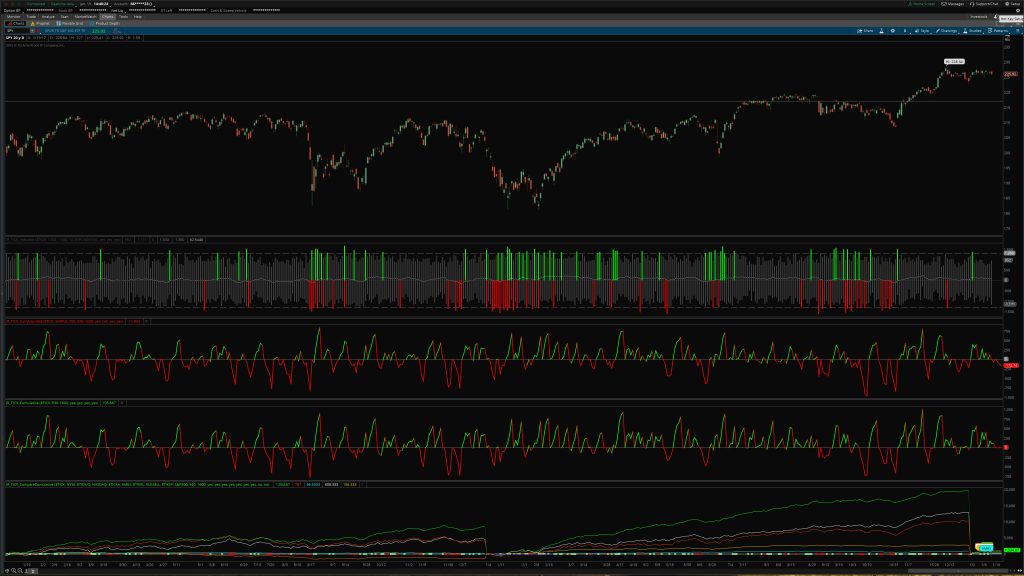
cumulative tick indicator set

New BONUS Indicator: TICK Extremes Indicator

This is an indicator that a lot of traders use to fade high and low TICK extremes. I’ve tried to make it really easy to customize by letting you show or hide the zero line, average line, and extreme levels. You can choose what levels you want to use based on whether you’re on a long term chart or a short term chart. And you can set the average type and length as well. All the colors and graph types are customizable as well.

tick extreme indicator thinkorswim

New BONUS Indicator: Comparative TICK Indicator

I’ve seen traders use this in other platforms, and I had some time to kill so I thought I’d see what I could do with it in TOS. Essentially this indicator lets you look at multiple cumulative TICKs at the same time and compare how different markets are behaving relative to each other. So you might compare the NYSE TICK to the Nasdaq TICK, S&P 500 TICK, Dow TICK, etc. The automatic comparison line lights up green when all the TICKs are up-ticking, and red when all the TICKs are down-ticking. You can literally type in any comparison TICK symbol available in Thinkorswim.

comparative tick indicator for thinkorswim

The complete list of TICK symbols is listed here for easy access:

  • $TICK – NYSE
  • $TICK/Q – Nasdaq
  • $TIKA – Amex
  • $TICKAC – Amex composite
  • $TICKAR – ARCA
  • $TICKARC – ARCA composite
  • $TICKC – NYSE composite
  • $TICKC/Q – Nasdaq composite
  • $TIKI – DJIA
  • $TIKIC – DJIA composite
  • $TIKND – Nasdaq 100
  • $TIKNDC – Nasdaq 100 composite
  • $TIKRL – Russell 2000
  • $TIKRLC – Russell 2000 composite
  • $TIKSP – S&P 500
  • $TIKSPC – S&P 500 composite
  • $TIKUS – All USA
  • $TIKUSC – All USA composite

Summary

So just as a quick recap, the cumulative TICK indicator set has been improved and updated with the following new features:

  • Works on all instruments
  • Works on any time frame
  • Custom yearly, monthly, weekly reset function to make it useful on long-term charts
  • Choose your own average type and length for the adjusted cumulative TICK
  • Set a custom closing and opening time if desired
  • New TICK extremes indicator lets you fade high and low TICK readings
  • New comparative TICK indicator lets you see how the different markets are doing relative to each other

This set comes with 4 separate thinkScripts. It includes the basic Cumulative TICK indicator, the Adjusted Cumulative TICK indicator, the TICK Extremes Indicator, and the Comparative TICK indicator.

You can check out the screenshots, video and description of the Cumulative TICK indicator here.

Posted on 2 Comments

How to Install ThinkOrSwim Indicators, Studies, Scans, Columns & Strategies [VIDEO]

Install ThinkOrSwim Indicators

ThinkOrSwim is a great platform, but let’s face it: some things are just plain confusing. Luckily, some of us have already been through the trial and error and know how to do a lot of the stuff you want to know how to do. So in this tutorial, I’ll go through a few of those things. In particular, I’m going to teach you how to install ThinkOrSwim indicators and other thinkScripts.

There are actually 2 methods for installing thinkScripts.

    1. Clicking the sharing links
    2. Copying and pasting the sharing links manually

We’ll go through each on in it’s turn. I’ve also included a video below that will walk you through each and every method except the first one, since it’s pretty easy.

VIDEO TABLE OF CONTENTS:
0:59 How to Install a SCAN
2:01 How to Load a scan in the main StockHacker scanner window after installing it
2:12 How to Load a scan in a sidebar watchlist widget – refreshes automatically every 3 minutes
2:53 How to Install a COLUMN
3:17 How to Load a column on a sidebar watchlist after installing it
3:54 How to change the timeframe of a column
4:07 How to install an INDICATOR or chart study
4:34 How to load an indicator or study onto a chart after installing it
5:09 How to install a STRATEGY file
5:26 How to load a strategy file onto a chart after installing it
5:43 Summary and recap

How to Find Your ThinkOrSwim Import Links

If you’ve just purchased an indicator on our site, all your links will in the My Account section under Orders. First, mouse over the “My Account” menu item at the top right of the page, then click “Orders” in the drop-down menu:

finding your thinkorswim links

On the next page, you’ll see all your orders. Click the one you’re interested in viewing the links for:

thinkorswim orders page

When your order details page pops up, you’ll see your import links below, as well as your file downloads should you want them later:

thinkorswim order details with sharing links

Now that you have your import links, it’s time to go through the actual installation process.

Method 1: Clicking the ThinkOrSwim Sharing Links

This method is pretty easy and straight-forward. Or so you would think anyway. Each ThinkScript can be shared with its own unique “tos.mx” sharing link. Clicking one of these links will take you to a page on ThinkOrSwim’s website where you can confirm what the script is. The page looks like this:

install thinkorswim indicators with sharing links, confirmation page

Then if you approve, you can click the green confirmation button (the one that says “Scan now in thinkorswim”). The file should be automatically imported into your TOS application.

I say should because it doesn’t work on all systems. Specifically those where TOS isn’t installed for all users. For those lucky traders, the green button will ask you to reinstall TOS. But if you don’t want to do that, no problem! You’ll just need to skip to method two below.

Method 2: Copying & Pasting the TOS Sharing Links

If the automatic link method above doesn’t seem to work, don’t fret. Just go into your ThinkOrSwim application, and click the “Setup” menu in the top right corner (gear icon). In the dropdown menu that appears, click “Open shared item”.

install thinkorswim indicators by copying sharing links step 1

Then a box will pop up, and you can simply copy and paste the link into the space that says “Shared item URL”. You have to go through this process one link at a time unfortunately. After you paste in the link, click “Preview”:

install thinkorswim indicators by copying sharing links step 2

The program will load the link into memory and grab the name so you’ll know for sure what you’re importing. If everything looks good, then click “Open”:

install thinkorswim indicators by copying sharing links step 3

A confirmation dialog box will pop up telling you the script has been imported and given a machine-generated name. Click “Rename” to change the name to something that will be easy for you to find in an alphabetical list later:

how to install thinkorswim indicators by copying sharing links step 4

Remember to give it an easy to remember name, but something unique as well:

install thinkorswim indicators by copying sharing links step 5

Voila! You’re done. The script has been imported and saved under your chosen name. See the end of this post for instructions on how to load and use each of the scripts you’ve just imported.

Now that you’ve figured out how to get the code into ThinkOrSwim, it’s time to actually activate the code and start using it. Here’s a brief rundown of how to find and activate thinkScripts that you’ve recently imported into ThinkOrSwim…

How To Load a Chart Study or Indicator

If you were importing a chart study (or indicator), then you just need to go to charts > studies > edit studies, and search for the script name in the list. Then double-click to add it to the chart (or click “Add Selected” below), and then click OK to apply the changes:

add a thinkorswim study or strategy to chart

Keep in mind if you didn’t give the study a name during the import process, it might be in the alphabetical list under “Fs” for “From Easycators on XYZ Date”, so be sure to check the “Fs” if you don’t see the study/indicator after searching.

How To Load a Strategy File

If you were importing a strategy file, then you’ll still go to the Charts > Studies > Edit Studies window, but instead of searching in the normal list of studies, you’ll switch to the “Strategies” tab on the top left corner of the Edit Studies window, and then search in that list for the strategy file:

thinkorswim strategies

Again, keep in mind if you didn’t give it a name during the import process, it might be in the alphabetical list under “Fs” for “From Easycators on XYZ Date”, so be sure to check the “Fs” if you don’t see the strategy after searching.

How To Load a StockHacker Scan

If the link you just imported was a scan, a window will pop up with the scanner rules ready-to-go. Just click scan and watch it work. You might have to resize and expand the window to see the results. Or you can close that popup and load the scan in your main window as well. You can access your scans at any time from the dark gray menu on the top right:

how to load a thinkorswim stockhacker scan query

Keep in mind if you didn’t give the Scan a name during the import process, it might be in the alphabetical list under “Fs” for “From Easycators on XYZ Date”, so be sure to check the “Fs” if you don’t see the scan after searching.

How to Load a Custom Quote or Watchlist Column

If you just imported a column thinkScript, there are a couple of ways to activate and use it. You can use columns in the MarketWatch Quotes tab, or in the StockHacker or OptionsHacker scan tabs, or on a sidebar watchlist on the left hand side of the window. In either case, you’ll first right-click anywhere on the column headers and select “Customize…”

add a watchlist quote column step 1

A window pops open with a list of columns you can add. Just find the column name in the alphabetical list, and double-click to add it to the right hand side. Then click OK:

add a watchlist quote column step 2

The column will now appear on your quote screen (whichever column header you had originally right-clicked on):

add a watchlist quote column step 3

Keep in mind if you didn’t give the Column a name during the import process, it might be in the alphabetical list under “Fs” for “From Easycators on XYZ Date”, so be sure to check the “Fs” if you don’t see the column after searching.

Conclusion

That should just about do it. Now you should have all your scans, strategies, columns, and studies/indicators imported and installed. Not only that, but if you went through the second part of the tutorial, you should have the thinkScripts added to your screens and ready to roll.

If you find you’re still unsure of how to do something, check out my video. I walk through almost all of these methods on the screen for you, and it should help you figure out anything you missed:

If you have any questions or issues, please post a comment below!